The Republican 2026 Budget Resolution Unlocks Reconciliation 2.0: The Sequel Isn’t Any Better
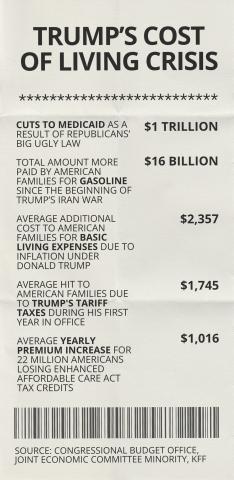
Trump and Congressional Republicans used reconciliation to pass the most unpopular piece of legislation in American history – the Big Ugly Law – throwing 15 million people off their health care, gutting nutrition assistance, and decimating Medicaid. In addition, inflation, tariffs, war, and uncertainty have ballooned costs for Americans at the grocery store and the gas pump. This week House Republicans are considering a budget for 2026 that initiates another round of reconciliation so they can push through more unpopular policies that Americans don’t support.
Instead of taking steps to relieve the pressure on families caused by their actions, Republicans are writing another massive check for masked and poorly trained Immigration and Customs Enforcement (ICE) troops to terrorize communities. Republicans could be helping Americans afford health care but instead choose to shut down neighborhoods and frighten schoolchildren. Republicans gloss over ICE’s shocking brutality and the murder of American citizens, claiming ICE is apprehending criminals. But fewer than a quarter of those ICE rounded up in Minnesota had a criminal record.
Reconciliation to Make an End Run Around the Appropriations Process
House Republicans refuse to pass a bipartisan Homeland Security appropriations bill and are now using reconciliation to bypass negotiations and fast-track their spending wish list. In doing so, Republicans will arm ICE and Customs and Border Protection (CBP) through the next three years by a simple majority vote in the Senate. Then they’ll force the House to rubber-stamp it, and send it to the President.
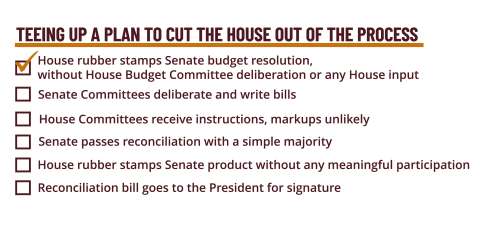
The reconciliation “instructions” in the budget allocate $70 billion each to the Homeland and Judiciary committees in the House and Senate as spending targets, permitting up to $140 billion in total. Since the committees share some jurisdiction, Republicans reportedly intend for the committees to produce a reconciliation bill that spends $70 billion for ICE and CBP combined. These new amounts are on top of the $140 billion ICE and CBP received in the Big Ugly Law.
What Else Is in the Budget Resolution?
Setting up Iran war funding. Section 4108 of the budget provides for emergency consideration of discretionary spending in the House, making a future supplemental for Iran easier to implement.
Unspecified and unrealistic spending cuts. Over ten years the budget assumes a $1.2 trillion increase in defense spending, but a $10 trillion cut to other programs. These gigantic cuts are unspecified and unlikely to materialize, given Republicans’ history of paying lip service to spending restraint but not following through. If cuts this size did happen, they would represent a reduction of nearly 13 percent of total spending (mandatory and discretionary, excluding interest), a quarter of all non-interest spending if Social Security and Medicare are protected, or the entirety – 100 percent – of non-defense discretionary spending.
Phony deficit numbers. The budget claims to eventually bring deficits down to 3 percent of GDP, in part through these imaginary spending cuts. It assumes a 2026 deficit of $1.265 trillion – for comparison, CBO projects a 2026 deficit of $1.853 trillion and OMB a deficit of around $2 trillion – suggesting that while Congress increases the deficit with the reconciliation process, it will also reduce the deficit by $600 billion in the next five months.